

In industrial wastewater management, choosing the right dewatering equipment is not simply a matter of preference it is a technically critical decision that can affect everything from operational costs to regulatory compliance. Whether in municipal treatment plants, food and beverage factories, or agro industrial facilities, an efficient sludge dewatering system ensures the reduction of waste volume, recovery of reusable water, and compliance with environmental standards. However, not all dewatering equipment performs equally well under different sludge conditions or operational environments.
1. Sludge Characteristics and Equipment Compatibility
The type of sludge being treated is the most fundamental variable when selecting dewatering equipment. Sludge can vary greatly in origin—ranging from municipal biosolids to oily wastewater from food industries—and each type responds differently to mechanical dewatering. A sludge dewatering system must be engineered to handle the specific water retention properties, particle sizes, and organic content of the material it processes. For instance, biological sludge rich in microbial flocs typically requires more gentle but consistent pressure to achieve effective dewatering, while fibrous sludge from palm oil or pulp industries may demand robust machinery with abrasion resistant surfaces.
Failure to match the right dewatering equipment with the specific sludge profile often results in inefficiencies such as low cake dryness, polymer overdosing, or mechanical breakdowns. Therefore, successful system implementation begins with a laboratory scale sludge analysis, followed by pilot scale trials with candidate machines. These steps ensure the selected sludge dewatering system is technically compatible and economically viable for the long term.
2. Operational Efficiency and Continuous Process Demands
In facilities operating around the clock, the ability of dewatering equipment to run continuously and autonomously is a crucial advantage. Batch operated technologies such as filter presses can become process bottlenecks due to their loading/unloading cycles. In contrast, continuous sludge dewatering systems, particularly screw presses and rotary drum thickeners, are designed to handle variable flow rates and fluctuating solids concentrations without frequent operator intervention.
Mechanical simplicity often translates to higher uptime. For example, screw type dewatering equipment operates at low rotational speeds, which not only reduces energy use but also minimizes mechanical stress and the frequency of maintenance interventions. In demanding industrial settings, this reliability translates directly to lower OPEX and greater throughput.
3. Chemical Conditioning and Polymer Optimization
Most sludge dewatering systems rely on chemical conditioning to enhance solids separation. The interaction between polymers and sludge flocs determines the efficiency of water release during mechanical processing. Equipment with poor polymer blending zones or limited adjustability often results in sub optimal dewatering performance and excessive chemical use.
High quality dewatering equipment should be equipped with precise dosing systems, real time monitoring, and adjustable polymer mixing mechanisms. These features allow operators to fine tune performance based on real time sludge variability, thus minimizing chemical consumption while maintaining high cake dryness.
4. Energy Consumption and Lifecycle Value
Beyond capital expenditure, the most overlooked aspect of dewatering equipment is its total cost of ownership over a 10–15 year operational life. Equipment that offers energy efficient operation—through low speed motors, VFDs (Variable Frequency Drives), or gravity assisted designs—can save thousands in utility costs annually. For example, centrifugal sludge dewatering systems may achieve excellent cake dryness but do so at the expense of high energy input and frequent maintenance due to high speed operation.
In contrast, modern screw press based dewatering equipment strikes a strong balance between dryness, energy efficiency, and minimal wear part replacement. This balance is particularly important in industries where sustainability goals and energy savings are closely tied to investment justifications.
5. Control Systems, Automation, and Data Integration
Digital integration is another hallmark of quality dewatering equipment. Systems that feature PLC based controls, remote monitoring, and automated fail safes are far more adaptable to today’s decentralized plant management models. Facilities operating with lean staffing or across remote locations benefit greatly from equipment that self regulates, reports performance anomalies, and allows remote diagnostics.
An advanced sludge dewatering system should function as part of an integrated water treatment line, with clear communication protocols to SCADA systems, data historians, and process controllers. This ensures the equipment not only meets mechanical requirements but contributes strategically to operational intelligence and resource management.
FLOWREX Multi Plate Screw Press: Grinviro Global’s Solution for Next Gen Dewatering Equipment
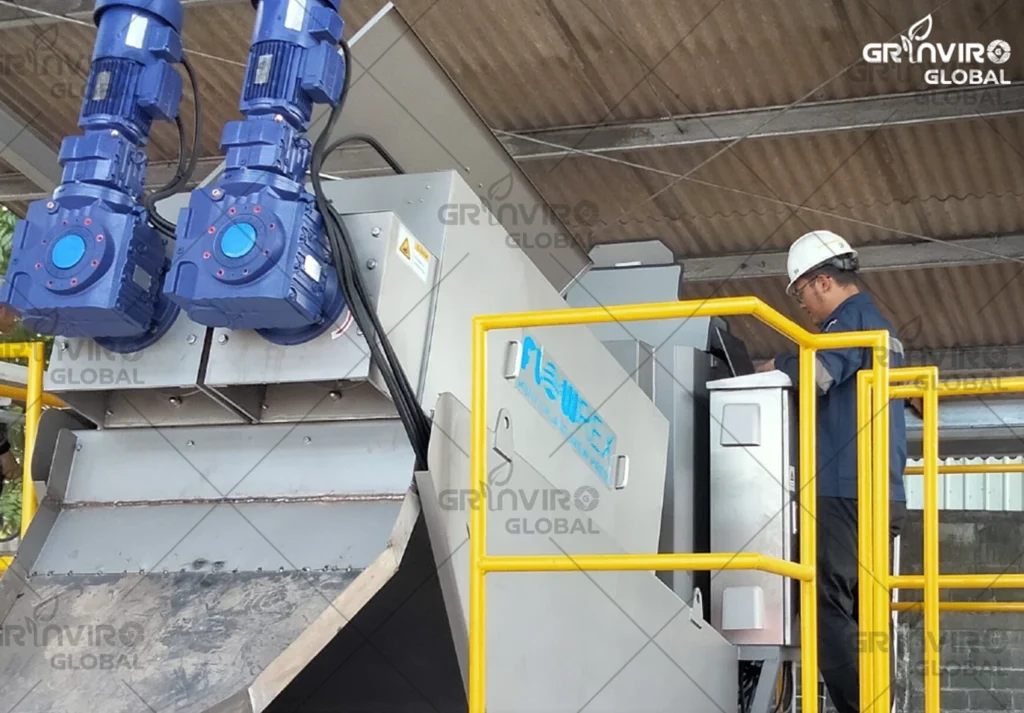
Among the many technologies in the sludge dewatering system market, the FLOWREX Multi Plate Screw Press from Grinviro Global represents a next generation solution that merges mechanical ingenuity with process adaptability. Unlike generic models that struggle with diverse sludge profiles found in Southeast Asia, FLOWREX is engineered specifically for mixed sludge types, fluctuating solid content, and variable process loads.
What differentiates FLOWREX is its multi plate structure combined with a self cleaning screw mechanism, which prevents clogging and ensures stable operation even during sludge inconsistencies. This makes it highly suitable for industries like palm oil, tofu production, fishery processing, and municipal plants where sludge composition can change daily. Moreover, its low speed operation results in outstanding energy savings and reduced equipment wear, giving it a superior edge in long term cost control.
The design also takes into account spatial and maintenance constraints commonly faced in retrofitted wastewater facilities. The compact footprint of FLOWREX allows it to be installed in limited spaces without compromising capacity. Combined with its intuitive interface and local technical support from Grinviro Global, it becomes an ideal candidate for companies seeking high performance dewatering equipment backed by reliable after sales service.
Crucially, FLOWREX is more than just a machine—it is a strategic platform designed to improve operational stability, reduce polymer and power usage, and ensure consistent performance under dynamic conditions. It supports advanced control logic, telemetry integration, and real time adjustment, all of which are rare in mid market sludge dewatering systems.
Conclusion
Choosing the right dewatering equipment is a technical decision that affects every aspect of a wastewater treatment operation—from energy costs and chemical consumption to compliance and final sludge disposal. An effective sludge dewatering system must align with the specific characteristics of the sludge, operational demands, and long term financial goals. The FLOWREX Multi Plate Screw Press by Grinviro Global exemplifies this alignment, offering superior performance, adaptability, and support. For operations seeking a sustainable, high efficiency solution, FLOWREX is not just an equipment choice—it’s a strategic investment in operational excellence.

Visit Us:
- 7th floor,1#Building ,No.200 Sanmen Road ,Yangpu District ,Shanghai ,China
- The Prominence Office Tower Lt. 28, Jl. Jalur Sutera Barat, Tangerang
- Jl Utama Modern Industri Blok AA No.5, Kawasan Modern Industri Cikande
- Ciputra World Office Surabaya Lt. 29, Jl. Mayjen Sungkono, Surabaya
- Pattene Business Park Blok W3a Makassar