

As global energy demand continues to grow, the oil and gas industry faces a dual challenge: increasing production efficiency while minimizing environmental impact. Among the most critical—and often underestimated—challenges is water management during drilling and hydraulic fracturing operations. With sustainability now central to operational strategy and investor expectations, water recycling in oil & gas is no longer optional; it is a business imperative.
This article dives into the pressing water related challenges faced during exploration and production (E&P), the role of advanced produced water treatment technologies like membrane bioreactors (MBR) and reverse osmosis (RO), and how strategic water reuse significantly improves environmental compliance and reduces a company’s overall water footprint.
The Hidden Cost of Water in Oil & Gas Operations
Water is a critical input in upstream oil and gas operations—particularly during drilling and hydraulic fracturing (fracking). A single fracked well can consume anywhere between 1 to 10 million gallons of water. This water is typically sourced from local surface water, groundwater, or municipal supplies, adding stress to already overburdened ecosystems.
But sourcing water is only half the problem. Once injected into the well, this water returns to the surface as produced water—a complex mixture of hydrocarbons, salts, heavy metals, and chemical additives. Managing this high volume, highly contaminated wastewater presents one of the most expensive and environmentally sensitive challenges in the entire production cycle.
Traditional water management relies heavily on deep well injection or offsite disposal, both of which are costly, risky, and increasingly regulated. Moreover, water trucking adds to carbon emissions, traffic congestion, and operational delays. As regulatory pressure intensifies and water scarcity becomes more acute, producers are recognizing that recycling produced water is not only environmentally responsible but economically strategic.
Advanced Treatment Technologies: From Waste to Resource
Recycling produced water requires advanced treatment technologies capable of handling the variable quality and complex composition of oilfield wastewater. Two technologies have emerged as industry frontrunners: Membrane Bioreactor (MBR) systems and Reverse Osmosis (RO) units.
BIOFLUX Membrane Bioreactor (MBR): Biological Precision Meets Mechanical Filtration
MBR technology combines biological treatment with membrane filtration in a single, compact unit. In this process, microorganisms biologically degrade organic pollutants, while semi permeable membranes act as physical barriers to suspended solids and pathogens.
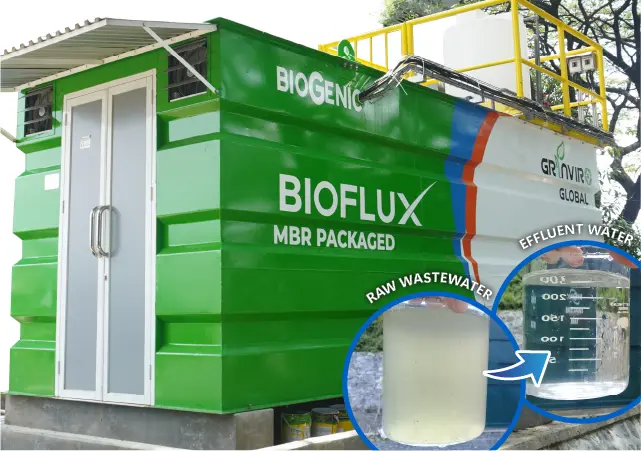
In oil and gas applications, MBR is particularly effective at treating produced water with high levels of biodegradable organic compounds. It delivers high quality effluent suitable for further polishing or direct reuse in drilling and fracking operations. Unlike traditional biological systems, MBR requires less space and offers greater control over effluent quality, making it ideal for modular or mobile setups deployed at remote well sites.
FLOWREX Reverse Osmosis (RO): The Final of Water Recycling
Reverse osmosis is often used as a final treatment step to remove dissolved salts and micro contaminants. The process forces water through a semi permeable membrane that blocks ions, molecules, and larger particles, resulting in high purity output.
When integrated after MBR or other pretreatment systems, RO can produce water that meets or exceeds environmental discharge standards—or even allows for direct reuse in subsequent fracking stages. However, RO systems require effective pretreatment to avoid membrane fouling and ensure long term performance.
The synergy between MBR and RO offers a multi barrier approach capable of transforming highly contaminated produced water into a reusable resource, closing the loop on water use in oil and gas operations.
Read also: Seawater Desalination Technology: A Solution to the Future Water Crisis
Impact on Water Footprint and Environmental Compliance
Water footprint defined as the total volume of freshwater used directly and indirectly by an operation—has become a key performance indicator for oil and gas producers aiming to align with ESG (Environmental, Social, and Governance) frameworks.
By implementing water recycling systems using MBR and RO, operators can dramatically reduce their dependence on freshwater withdrawals. In some shale plays, companies have achieved up to 90% – 95% water reuse, slashing their water footprint while maintaining or improving operational output.
In parallel, water recycling in oil and gas enhances compliance with increasingly strict environmental regulations. Regulatory bodies across North America, the Middle East, and Asia are raising the bar on water disposal, chemical discharge, and groundwater protection. Companies that fail to comply face not only fines but also reputational damage and project delays.
Water recycling systems especially those that are modular, automated, and built for scalability—enable operators to stay ahead of regulatory trends. They also reduce liabilities associated with deep well injection, such as induced seismicity and long term contamination risks.
Grinviro Global: Redefining Water Recycling for Oil & Gas
In a sector where every gallon and every dollar counts, Grinviro Global has emerged as a trusted partner for water recycling in oil & gas. With a deep understanding of the operational and environmental pressures facing E&P operators, Grinviro provides tailored, high efficiency solutions that bridge the gap between compliance and performance.
What sets Grinviro apart is their technological integration. Their systems combine MBR and RO in a cohesive, automated platform designed for remote deployment. These plug and play units require minimal operator intervention, deliver consistent water quality, and can be scaled quickly as operations expand.
Grinviro’s clients report not only reduced freshwater consumption and disposal volumes but also improved ESG ratings, smoother audits, and greater investor confidence. Their water treatment solutions are engineered to meet the highest industry standards while optimizing operational cost structures.
In a recent shale basin project, Grinviro deployed a modular MBR and reverse osmosis system that recycled over 75% of the produced water onsite, reducing the need for freshwater hauling and cutting disposal costs by more than 40%. The system ran autonomously with remote monitoring, requiring no additional manpower a crucial advantage in labor constrained environments.
Conclusion
Water recycling in oil & gas is rapidly shifting from an environmental afterthought to a strategic necessity, driven by escalating water scarcity, regulatory demands, and ESG expectations. With advanced technologies like membrane bioreactors and reverse osmosis, producers can turn produced water from a liability into a reusable asset cutting operational costs, shrinking their water footprint, and staying ahead of compliance risks. Companies like Grinviro Global are enabling this transition by delivering robust, field proven systems that align operational efficiency with environmental responsibility.

Visit Us:
- 7th floor,1#Building ,No.200 Sanmen Road ,Yangpu District ,Shanghai ,China
- The Prominence Office Tower Lt. 28, Jl. Jalur Sutera Barat, Tangerang
- Jl Utama Modern Industri Blok AA No.5, Kawasan Modern Industri Cikande
- Ciputra World Office Surabaya Lt. 29, Jl. Mayjen Sungkono, Surabaya
- Pattene Business Park Blok W3a Makassar